
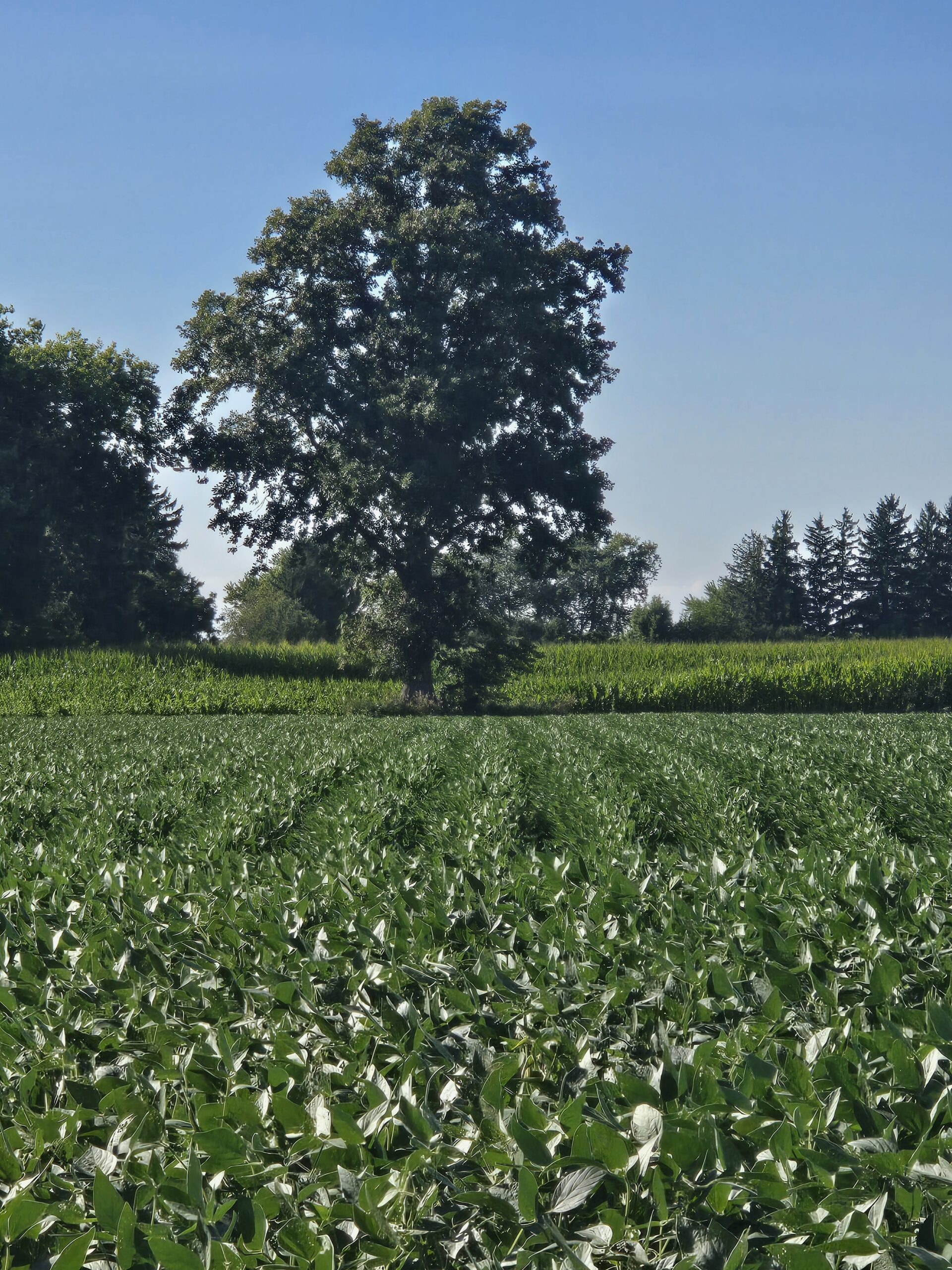
Why Haven’t Soybean Rows Closed as Quickly This Year?
Many Ontario soybean fields have been slower to achieve row closure than normal in 2026. While later than average planting date contributed in some areas, weather conditions after planting likely played an equally important role. Cool early-season temperatures, below-normal rainfall, and slower canopy development reduced the crop’s ability to rapidly intercept sunlight during the longest days of the growing season.
Soybean canopy development is critical because it determines how quickly a crop captures sunlight and converts it into biomass. During vegetative growth, soybeans build leaf area, nodes, branches, and stems that ultimately support pod production and yield. Delays in canopy development can reduce the amount of solar radiation captured during May, June, and early July when day length is near its annual maximum.
Ontario data cited by OMAFRA indicate that delaying soybean planting by approximately one month shortens the vegetative growth period, resulting in fewer nodes, shorter plants, and delayed canopy closure. Maturity may be delayed by approximately nine days, and yield potential declines as planting is pushed later into the season.
Weather conditions after planting likely magnified these effects. In Chatham-Kent, 2026 average temperatures were 12.8°C in May, 20.1°C in June, and 23.2°C in July. Soybeans can emerge under cool conditions, but optimum growth generally occurs near 18°C (65°F). Cooler temperatures slow node appearance, leaf expansion, and stem elongation, resulting in smaller plants and delayed row closure.
Moisture was also limited. Chatham-Kent received only 52.8 mm of rainfall in May, 69.6 mm in June, and 36.8 mm in July, for a total of 159.2 mm between May and July. This is approximately 35-45% below the normal seasonal precipitation for much of southwestern Ontario. Moisture stress during vegetative growth can reduce leaf size and canopy expansion, delaying the crop’s ability to fully cover the row middles.
The issue was not daylength but the crop’s ability to intercept available solar radiation. Research shows soybean canopies intercept less than 1% of incoming sunlight at emergence and nearly 100% once full canopy closure is achieved. Delayed canopy development therefore reduces the amount of solar energy captured during the longest days of the growing season. Although the effects will be secondary, the few days of forest fire smoke will reduce the amount of solar radiation captured in 2026 as well.
Peer-reviewed research further demonstrates that early-planted soybeans reached 90% green canopy cover 7 to 9 days sooner than later-planted soybeans. Narrow-row soybeans also achieved canopy closure 4 to 7 days sooner than wider-row soybeans. Earlier canopy development improved sunlight interception and was associated with yield advantages ranging from 188 to 902 kg/ha.
Additional peer-reviewed research has shown that canopy development is strongly related to yield potential. A North Dakota study found canopy measurements explained 49-56% of soybean yield variation, while other research demonstrated that greater canopy light interception significantly increased dry matter accumulation and yield.
Bottom Line
The slower row closure observed in many Ontario soybean fields this year is likely the result of several interacting factors:
- Later planting shortened the vegetative growth period.
- Cool temperatures slowed node development and leaf expansion.
- Below-normal rainfall reduced canopy growth.
- Delayed canopy formation reduced the crop’s ability to capture available sunlight during the longest days of the season.
- Wider row spacings further extended the time required to achieve full canopy closure.
While some fields remained more open than normal through early July, soybeans are highly adaptable. Favourable weather during August can still allow plants to add nodes, branches, and pods, helping protect yield potential despite slower early-season canopy development.
References
Syngenta Canada Agronomy Hub. June Planted Soybeans.
https://www.syngenta.ca/agronomy/june-planted-soybeans [syngenta.ca]
Iowa State University Extension and Outreach. Why Are My Soybeans Growing So Slowly? (June 12, 2025).
https://crops.extension.iastate.edu/post/why-are-my-soybeans-growing-so-slowly [crops.exte…astate.edu]
Soybean Science for Success. The Soybean Growth Cycle: Important Risks, Management and Misconceptions (May 5, 2025).
https://soybeanscienceforsuccess.org/2025/05/05/the-soybean-growth-cycle-blog/ [soybeansci…uccess.org]
Farm Progress. Short Soybeans Raise Concern (July 1, 2020).
https://www.farmprogress.com/soybean/short-soybeans-raise-concern [farmprogress.com]
Farm Progress. Later-Planted Soybeans May Push Envelope on Canopy Closure (June 15, 2017).
https://www.farmprogress.com/soybean/later-planted-soybeans-may-push-envelope-on-canopy-closure [farmprogress.com]
Arsenijevic, N., DeWerff, R., Conley, S., Ruark, M., & Werle, R. Influence of Integrated Agronomic and Weed Management Practices on Soybean Canopy Development and Yield. Weed Technology 36(1), 2022.
Cambridge University Press:
https://www.cambridge.org/core/journals/weed-technology/article/influence-of-integrated-agronomic-and-weed-management-practices-on-soybean-canopy-development-and-yield/4A6BCF83F6F957C47C45B87261D7D268 [cambridge.org]
Schmitz, P.K. & Kandel, H.J. Using Canopy Measurements to Predict Soybean Seed Yield. Remote Sensing 13(16):3260, 2021.
https://www.mdpi.com/2072-4292/13/16/3260 [mdpi.com]
Virdi, K.S. et al. Branch Angle and Leaflet Shape Are Associated with Canopy Coverage in Soybean. The Plant Genome, 2023.
https://acsess.onlinelibrary.wiley.com/doi/10.1002/tpg2.20304 [acsess.onl….wiley.com]
Tenorio, F.A.M. Temperature Control of Node Appearance and Initiation in Soybean. University of Nebraska-Lincoln, M.Sc. Thesis, 2016.
https://digitalcommons.unl.edu/agronhortdiss/106/ [digitalcom…ns.unl.edu]
WeatherStats Canada. Chatham-Kent historical weather data (temperature and precipitation), accessed August 2026.
Temperature: https://chathamkent.weatherstats.ca/charts/temperature-monthly.html
Precipitation: https://chathamkent.weatherstats.ca/charts/precipitation-monthly.html [chathamken…erstats.ca] [chathamken…erstats.ca]