Planting Soybeans Early in Ontario: Three Questions to Ask Before the Planter Rolls
Interest in planting soybeans earlier than the traditional window continues to grow across Ontario. Research consistently shows yield advantages to earlier planting, but those benefits come with agronomic and financial risks—especially on heavy clay soils common across much of the province.
Before committing to ultra‑early or early soybean planting, growers should step back and answer three key questions:
- What are the main objectives?
- Is the ground and weather fit?
- Do you need to take the risk?
1. What Are the Main Objectives of Planting Soybeans Early?
The primary driver behind early soybean planting is yield potential. Soybeans are photoperiod‑sensitive, meaning earlier planting allows more time for vegetative growth and node development before flowering is triggered after the summer solstice. More nodes typically translate into more pods and higher yield potential.
Ontario research consistently shows that maximum soybean yields are achieved when planting occurs from late April through the first half of May, with yield declining steadily as planting is delayed into late May and June.
Figure 1. Soybean Yield vs. Planting Date (Ontario Trend)

Figure 1. Typical soybean yield response to planting date in Ontario. Yield potential remains near maximum when soybeans are planted in late April and early May, then declines as planting is delayed into late May and June. Research consistently shows that delayed planting shortens the reproductive period and reduces yield potential, even when final plant stands are adequate.
Source: Ontario field data and University of Wisconsin Cool Bean research. Agronomic interpretation supported by NK®.
This figure highlights a key takeaway: soybeans lose yield potential quickly when planting is delayed. While soybeans can compensate for moderate stand losses, they cannot compensate for lost time once the growing season shortens.
Key takeaway:
Early planting increases yield potential by extending the crop’s productive window. Particularly increasing plant biomass during the reproductive stages.
2. Is the Ground & Weather Fit?
Early planting success depends far more on soil conditions and weather forecasts than on calendar date.
Soil Temperature and Clay Soils
OMAFRA recommends planting soybeans when soil temperatures are near 10°C and trending upward. Cold soils slow emergence and increase the risk of imbibitional chilling injury.
Heavy clay soils:
- Warm more slowly in spring
- Hold moisture longer
- Increase risk of crusting and seedling disease
On cold, wet clay soils, early‑planted soybeans may take 20–28 days to emerge, significantly increasing exposure to disease and early‑season stress.
❄️ Figure 2. Average Last Spring Frost Dates in Ontario
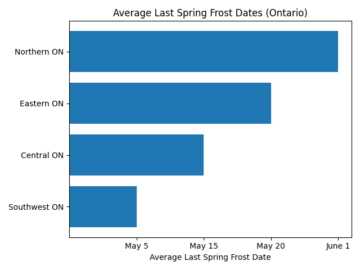
Figure 2. Average last spring frost dates across major Ontario regions. Frost risk extends into mid‑to‑late May in Central, Eastern, and Northern Ontario, increasing the likelihood that very early‑planted soybeans may emerge prior to the final frost event. Regional frost timing is a key factor when evaluating early soybean planting risk.
Source: OMAFA climate normals and regional agronomy research. Agronomic interpretation supported by NK®.
Soybeans can tolerate brief exposure to temperatures around ‑2 to ‑3°C, but injury risk depends on growth stage, soil moisture, and duration of cold temperatures. Planting early increases the likelihood that soybeans will emerge before the final frost, particularly outside of Southwestern Ontario.
Key takeaway:
The calendar may say “early May,” but frost and cold soil risks can still be very real—especially on clay soils and outside of Southwestern Ontario.
3. Do You Need to Take the Risk?
Early soybean planting often increases yield potential, but it also increases exposure to early‑season variability.
Ontario and University of Wisconsin research both show that:
- Early planting usually improves yield
- Cold springs with slow emergence can reduce or eliminate benefits
- Weather patterns ultimately determine outcomes
Early planting may be the right strategy when:
- Acreage is large and planting windows are tight
- Soils are well‑drained or lighter‑textured
- High‑quality seed and seed treatments are used
- Earlier harvest and workload management are priorities
Early planting carries higher risk when:
- Fields are dominated by heavy clay
- Soil conditions are marginal at planting
- Cold rain is forecasted shortly after seeding
- Stand loss would require replanting
Key takeaway:
Early planting should be intentional and selective, not automatic.
Final Thoughts
Early soybean planting can be a strong yield‑building strategy in Ontario when conditions are right. The data clearly shows that planting earlier preserves yield potential, but frost risk, soil temperature, drainage, and weather forecasts must drive the decision—not the calendar.
The goal is to plant soybeans as early as conditions allow, not as early as possible.