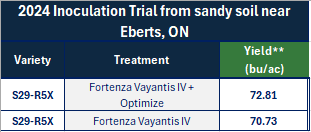
In recent years seed inoculation has been low because we grow soybeans in frequent rotation. “I don’t need it, I grow lots of beans” is a common mantra. The inoculation business has changed with new formulations, and the push for higher soybean yields has made us revisit the generally accepted norm. The last two years near Dresden we have been able to produce a favourable ROI. We would be the first to admit biologicals can be inconsistent, so the results may not occur every year. It seems ironic that a seed company would recommend an additional treatment. However, with multiple replications at a location, multiple sites over years and consultations with industry experts, it really does seem the industry has improved seed treatment products. Below is a snapshot of what we learned:
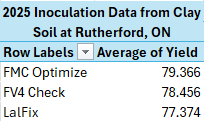

Why Soil / Growing Stress Lowers Nodulation — And Why Dual Inoculants Help
Stress factors that hurt nodulation:
Here are common soil and growth stresses that reduce the effectiveness or survival of rhizobia, thereby hurting nodulation:
Soil pH: Very acidic soils (pH < ~6) are less hospitable to rhizobia and can reduce nitrogen fixation.
High soil nitrogen (nitrate / ammonium): If there’s a lot of “free” inorganic N, the plant may suppress nodulation because it doesn’t need to rely on rhizobia.
Temperature extremes: Cool soils (early season) slow down nodule formation; very hot soils + drought can desiccate rhizobia.
Moisture stress: Both drought and waterlogging are damaging — drought can desiccate rhizobia; flooding can create low-oxygen conditions that kill them.
Texture / soil type: Sandy soils are more prone to drying, which hurts rhizobia survival. Also, lower organic matter soils may carry fewer indigenous rhizobia.
Compaction: Poor soil structure can limit root growth and reduce infection sites.
Low phosphorus: P is important for energy (ATP) in nodulation; low P can limit nodulation.
Why inoculation (especially dual / improved) can mitigate stress
Dual-strain or enhanced inoculant products like the two above help in several ways when soil or growing conditions are stressful:
Redundancy and strain competition: Two effective strains (e.g., in Optimize FXC DS or LALFIX ProYield) increase the chances that at least one strain will survive and infect, even if one strain is less competitive, or if native rhizobia or soil microbes compete. In LALFIX ProYield, the dual B. elkanii strains are chosen for survival / competitiveness, meaning they’re more likely to form nodules even when native populations are poor or competing.
Faster / earlier nodulation: In Optimize FXC DS, the LCO “signal” jump-starts communication between the plant and rhizobia, so nodulation begins earlier, which can be very helpful in short or stressful growing windows. Earlier nodulation means nitrogen fixation can begin sooner, supporting early plant growth and giving a buffer if stress hits later.
Improved root system and microbial synergy: The Delftia acidovorans in ProYield helps build a more complex, branched root system, which increases the infection sites for rhizobia. Delftia also helps with iron solubilization (iron is vital for nitrogenase, the enzyme rhizobia use to fix N), which can be limiting in some soils. In Optimize FXC DS, LCO also promotes mycorrhizal associations, which not only help water/nutrient uptake but also may help rhizobia colonization via improved root health.