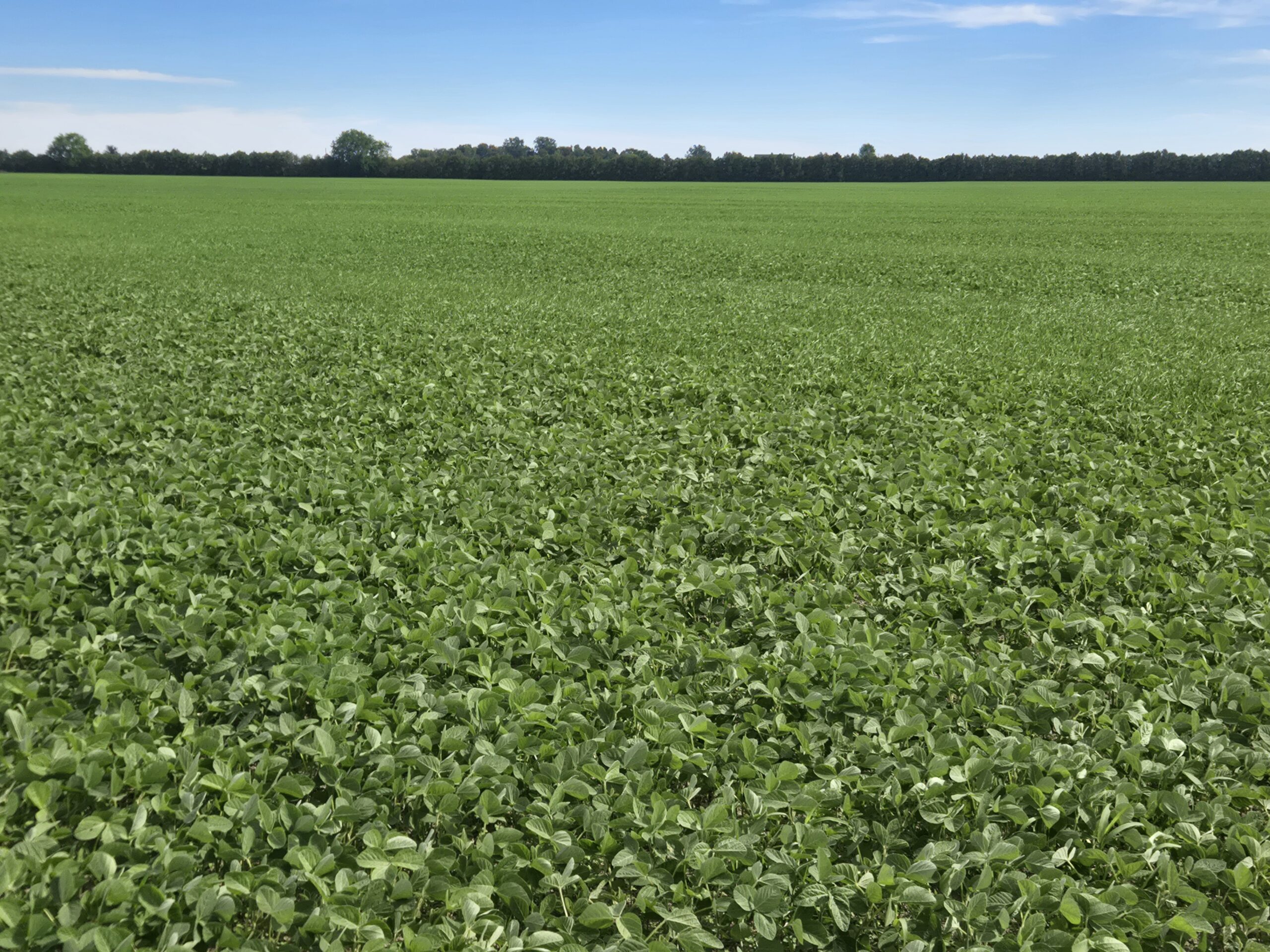
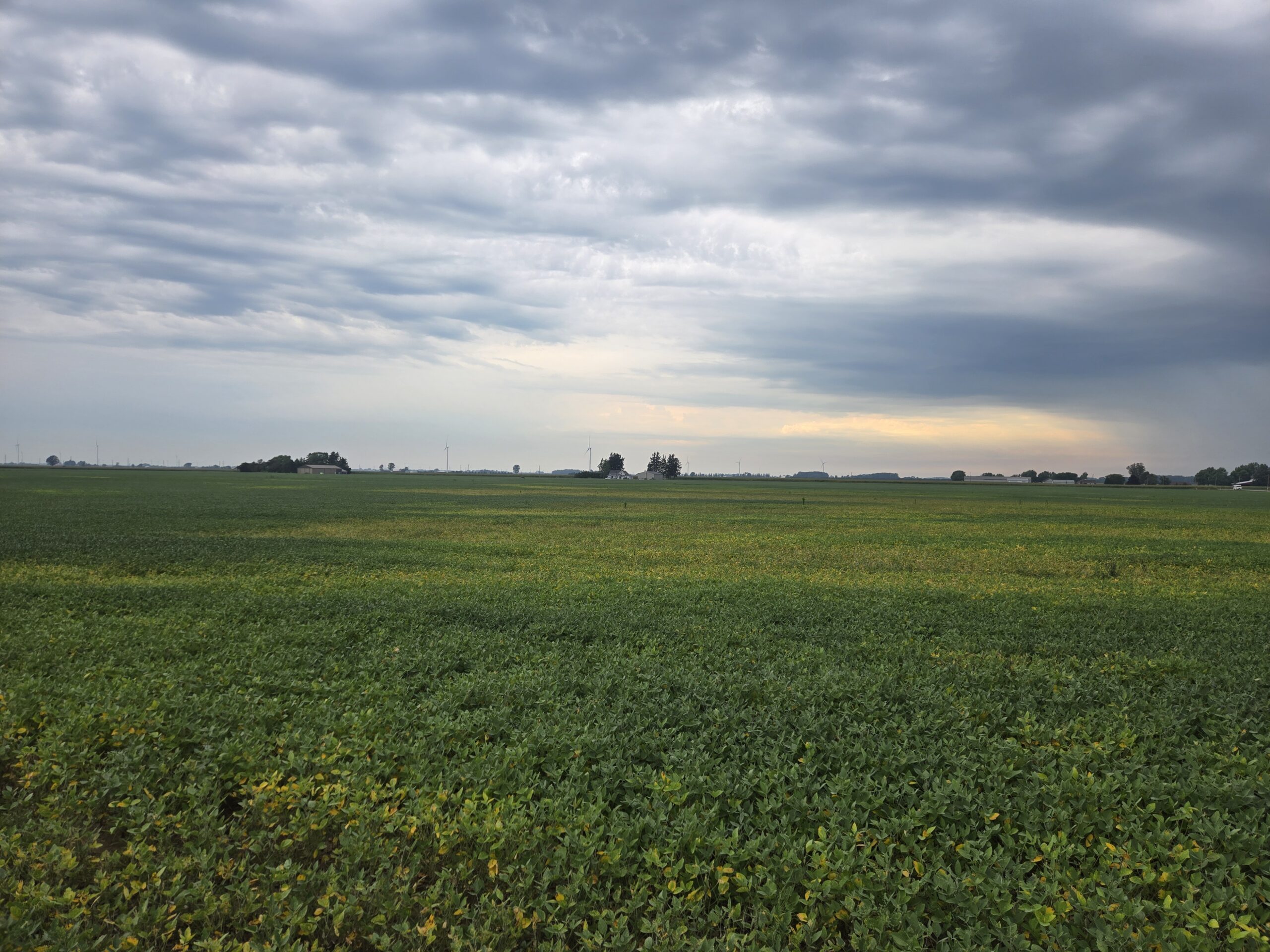
If your beans are yellowing in late August and early September, they may just be maturing. It’s about 3 weeks from the beginning of senescence until harvest. So plan on harvest the 3rd to 4th week of September. With that said yellowing could be a disease or nutrient deficiency. Unfortunately, at this point in the season a remedy is too late, but if you are curious about your symptoms we can go over some basic info.
In Ontario and the Great Lakes region, when soybean fields show yellowing or dying patches in August and September, the causes most frequently considered are:
Sudden Death Syndrome (SDS)
Potassium deficiency
Brown Stem Rot
Fusarium Wilt
Charcoal Rot during drought
Soybean Cyst Nematode injury
Manganese deficiency on high-pH soils
Based on the Compendium of Soybean Diseases and Pests, Fifth Edition, A Farmer’s Guide to Soybean Diseases, and Crop Protection Network (CPN) resources, the soybean diseases most commonly associated with yellowing, premature senescence, wilting, or dying plants during late August through harvest are listed below:
- Sudden Death Syndrome (SDS)
Pathogen: Fusarium virguliforme
Key Fall Symptoms
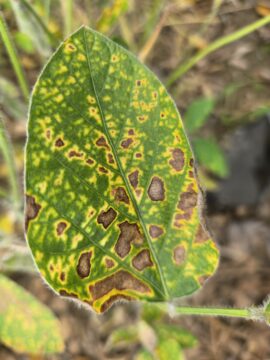
- Yellow spots develop between leaf veins.
- Symptoms progress to bright yellow and then brown necrotic tissue while veins remain green.
- Leaves may drop prematurely, leaving petioles attached to the stem.
- Plants often appear in patches across the field.
- Premature plant death and reduced pod fill can occur.
Diagnostic Features
- Roots are rotted and discolored.
- Stem pith remains white when split.
- Often confused with Brown Stem Rot.
When Symptoms Appear
- Typically from reproductive stages (R3-R7).
- Most noticeable in late summer and early fall.

- Brown Stem Rot (BSR)
Pathogen: Cadophora gregata
Key Fall Symptoms
- Interveinal yellowing and browning of leaves.
- Leaf curling and premature death.
- Plants may look like they are maturing early.
- Symptoms usually appear around pod fill to beginning maturity.
Diagnostic Features
- Chocolate-brown pith inside the stem.
- Roots generally remain healthy.
- External stem often appears normal.
When Symptoms Appear
- Most common during cool, moist seasons.
- Symptoms often become evident at R5-R7.
- Stem Canker
Pathogen: Diaporthe caulivora and D. aspalathi
Key Fall Symptoms
- Premature yellowing and death of entire plants.
- Dead leaves frequently remain attached to the plant.
- Plants occur in patches.
- Upper portions of plants may die back.
Diagnostic Features
- Sunken reddish-brown cankers near nodes.
- Cankers may girdle stems.
- Internal stem tissue may be brown near lesions.
- Unlike SDS, leaves typically remain attached after death.
When Symptoms Appear
- Commonly observed from R3 through maturity.
- Most obvious near harvest.
- Charcoal Rot
Pathogen: Macrophomina phaseolina
Key Fall Symptoms
- Premature yellowing and wilting.
- Plants die early, especially during hot, dry conditions.
- Upper pods may have poor seed fill.
- Frequently mistaken for drought stress.
Diagnostic Features
- Light gray or charcoal-colored lower stem and taproot.
- Tiny black microsclerotia visible in stem and root tissues.
- Dead leaves often remain attached.
When Symptoms Appear
- Usually after flowering through seed fill.
- Most severe under drought stress during August and September.
- Phytophthora Root and Stem Rot
Pathogen: Phytophthora sojae
Key Fall Symptoms
- Stunted plants.
- Yellowed foliage.
- Wilt and death of individual plants or field patches.
- Plants may die at any growth stage, including late season.
Diagnostic Features
- Dark brown lesion extending from the soil line upward on the stem.
- Root system often rotted.
- Frequently found in poorly drained areas.
The Compendium and Farmer’s Guide identify this disease as a major cause of patchy dying soybean plants, especially following wet periods.
- White Mold
Pathogen: Sclerotinia sclerotiorum
Key Fall Symptoms
- Wilting and yellowing during pod fill.
- Premature death of branches or entire plants.
- Plants often appear dead while neighboring plants remain healthy.
Diagnostic Features
- White cottony fungal growth on stems.
- Black sclerotia inside stems.
- Bleached stem appearance.
More common in cool, dense canopies and irrigated fields.
- Fusarium Root Rot and Wilt
Pathogens: Several Fusarium species, including Fusarium oxysporum and related species.
Key Fall Symptoms
- Yellowing (chlorosis) of middle and lower canopy leaves.
- Scorching of upper leaves.
- Wilting of stem tips.
- Premature leaf drop and plant decline.
- Stunted plants that may appear to mature early or die prematurely under drought stress.
Diagnostic Features
- Brown discoloration of vascular tissue within roots and stems.
- Poor nodulation.
- Reddish-brown to dark brown root rot.
- No obvious stem lesions above the soil line.
- White, orange, or reddish fungal growth may occasionally be visible on roots.
When Symptoms Appear
- Infection often occurs early in the season under cool, wet conditions.
- Symptoms become most evident during reproductive stages when hot, dry weather places stress on compromised root systems.
Risk Factors
- Soybean cyst nematode (SCN)
- Compaction
- Iron deficiency chlorosis
- Herbicide injury
- Poor drainage
- Drought stress during pod fill and seed fill
Quick Field Diagnostic Comparison
| Disease |
Leaf Symptoms |
Roots |
Stem Interior |
Leaves After Death |
| Sudden Death Syndrome |
Interveinal yellowing and browning |
Rotted |
White pith |
Petioles remain attached |
| Brown Stem Rot |
Interveinal yellowing and browning |
Healthy |
Brown pith |
Usually attached |
| Stem Canker |
Yellowing, necrosis, dieback |
Healthy |
Browning near cankers |
Leaves remain attached |
| Charcoal Rot |
Yellowing, wilting, premature death |
Gray-black discoloration |
Microsclerotia present |
Leaves remain attached |
| Phytophthora |
General yellowing and wilt |
Rotted |
Brown lesion from soil line |
Often attached |
| White Mold |
Wilting and bleaching |
Usually healthy |
White mold and black sclerotia |
Often attached |
| Fusarium Wilt |
Upper leaf scorch, lower leaf yellowing, wilting |
Brown root rot |
Brown vascular tissue |
May defoliate prematurely |
The most effective field diagnosis is to dig plants and split stems longitudinally, then examine:
- Root health
- Stem pith color
- Presence of cankers
- Whether leaves or only petioles remain attached
Disease vs. Nutrient Deficiency Quick Guide
| Problem |
Pattern on Leaf |
Field Pattern |
Roots/Stem |
| SDS |
Yellow between veins, veins stay green |
Patches |
Root rot, white pith |
| Brown Stem Rot |
Yellow between veins |
Patches |
Brown pith |
| Potassium Deficiency |
Yellow leaf edges |
Often broad areas |
Healthy |
| Magnesium Deficiency |
Interveinal yellowing on lower leaves |
More uniform |
Healthy |
| Manganese Deficiency |
Interveinal yellowing on upper leaves |
High pH zones |
Healthy |
| Nitrogen Deficiency |
Entire leaf yellow |
Broad areas |
Poor nodulation |
| Fusarium Wilt |
General yellowing and wilt |
Patches |
Brown vascular tis |
References:
Hartman, G. L., Rupe, J. C., Sikora, E. J., Domier, L. L., Davis, J. A., & Steffey, K. L. (Eds.). (2015). Compendium of soybean diseases and pests (5th ed.). American Phytopathological Society (APS Press).
Ontario Ministry of Agriculture, Food and Rural Affairs (OMAFRA). A Farmer’s Guide to Soybean Diseases. OMAFRA, Guelph, Ontario.
Crop Protection Network. (2025). Crop Protection Network. https://cropprotectionnetwork.org/publications